
Individual Therapy
Individual therapy is the most familiar form of mental health care — one room, one clinician, one hour at a time. It's also the most adaptable.
Learn about individual therapyMost of the people who walk in here have never done this before. They're tired in a way rest doesn't fix, or stuck in a pattern they can see but can't change, or simply curious whether life can feel a little easier. We're an outpatient mental health practice serving the Greater Los Angeles area — group, individual, couples, and family therapy across nine specialties, in eight languages, with evening and weekend hours. Telehealth seven days a week across California, most insurance accepted.

Available when openings allow — call to ask. Wait times are usually under a week.
Anthem, Blue Shield, Aetna, Cigna, L.A. Care, Magellan, Carelon, MHN, and more.
Across all services, in every modality, with every clinician on staff.
Open until 8pm weekdays and 4pm on weekends. Life doesn't pause at 5.
If this is your first time considering therapy, here is what the process actually looks like — start to finish, in plain language.
Call, email, or send a short message. Our healthcare coordinator answers questions, checks insurance, and helps you find a clinician who fits — including by language. There is no obligation.
About 60 minutes. A conversation, not an interview. You don't have to share everything in week one. Most people don't. The goal is to make sure the fit is right before going further.
Weekly or bi-weekly sessions, individually or in a group. We adjust the cadence and approach as you go. The plan is yours; we're guides, not gatekeepers.
They are tired in a way rest doesn't fix. They've been doing the same loop in their head for months. They're functional and unhappy, or unsure which one is true today.
Therapy isn't only for things that have already broken. It's also for things you'd like to feel different — the chronic Sunday-night dread, the pattern that keeps repeating in relationships, the feeling that something is off without a name for it yet.
If you've been wondering whether what you're carrying counts, that wondering is itself a reasonable signal to talk to someone. Starting is often the hardest part.
Talk to someone todayEach page below speaks to one specific experience, in plain language — not symptom checklists, not therapy-speak. Pick the one that sounds the most familiar.
We match the format to the person and the moment. The right kind of help looks different at week one than at month six.
Individual therapy is the most familiar form of mental health care — one room, one clinician, one hour at a time. It's also the most adaptable.
Learn about individual therapy
Most couples don't come to therapy at the start of trouble. They come at the point where their usual ways of fighting, repairing, and reconnecting have stopped working — and the same conversation is happening again, with smaller and smaller relief..
Learn about couples counseling
Group therapy is one of the most-researched and most-underused forms of mental health care. Decades of evidence show it as effective as individual therapy for many conditions — and for some experiences, more so.
Learn about group therapy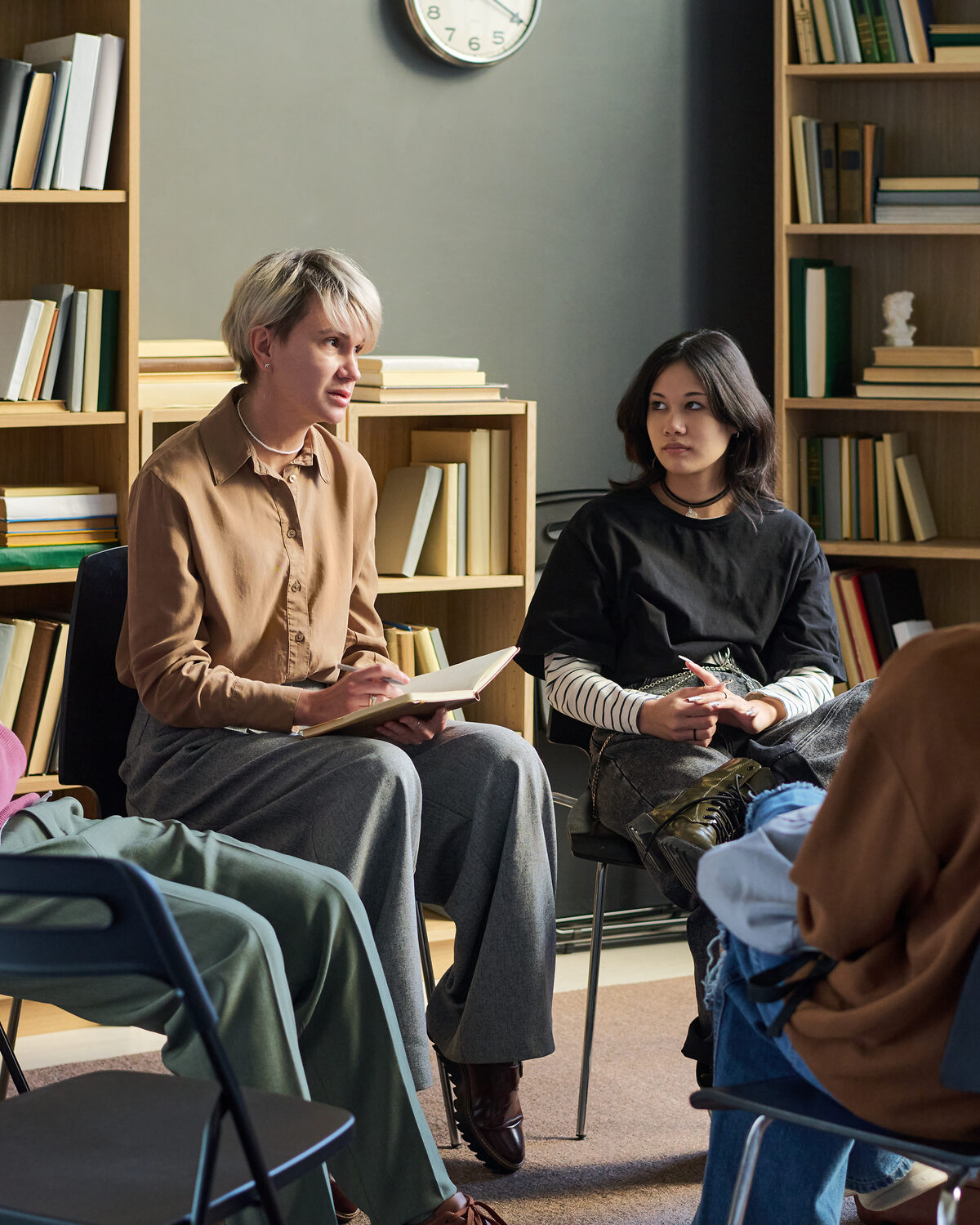
Family therapy isn't only for families in crisis. It's also for families navigating a transition — a teen pulling away, a parent declining, a marriage shifting, a sibling estranged, a household trying to find a new normal after something hard..
Learn about family therapy
An Intensive Outpatient Program (IOP) is a step between weekly therapy and inpatient care. It's the right level when weekly sessions aren't enough but a hospital isn't necessary — and for many people, it's the structure that finally helps things shift..
Learn about intensive outpatient program (iop)Our office is in Pasadena. Our clients live across the LA metro — from the San Gabriel Valley and Eastside neighborhoods to the Westside, Glendale–Burbank corridor, South Bay, and Orange County — with telehealth available across the rest of California.
Pasadena · South Pasadena · Altadena · Sierra Madre · Arcadia · …
Eagle Rock · Highland Park · Mount Washington · Atwater Village · Glassell Park · …
Downtown Los Angeles · Hollywood · West Hollywood · Koreatown · Mid-Wilshire · …
Glendale · Burbank · North Hollywood · Toluca Lake · Studio City · …
Sherman Oaks · Encino · Tarzana · Woodland Hills · Van Nuys · …
Beverly Hills · Bel Air · Brentwood · Westwood · Santa Monica · …
Quotes below are illustrative composites — placeholders to be replaced with verified, consented testimonials before launch. Real first-name-and-last-initial reviews will appear here once the launch consent process is complete.
I'd told myself for years that I just needed to manage better. The first session here was the first time someone made it feel like asking for help wasn't an admission — it was a reasonable next step.
I was nervous about therapy because I'd never had it. The intake call answered every question I didn't realize I had, and walking in for the first session felt easier because of it.
I'd held onto a lot for a long time. The group felt like the first place I didn't have to translate myself. People nodded the way you nod when you actually understand.
There's no part of my work that lets me be the one who needs care. Sitting in this group is the only place that flips for an hour, and I didn't realize how much I needed that.
In my family, talking to a stranger about your problems was something to be embarrassed about. It took me a year to walk in. I wish I'd done it sooner. The clinician understood without me having to explain everything.
I was scared therapy would mean I'd have to be a different person. It hasn't. I'm the same person — I just stopped fighting myself as much. That changed how everything feels.
No. Most of the people who come here are not in crisis. They are tired in a way rest doesn't fix, or stuck in a pattern they can see but can't change, or simply curious whether life can feel a little easier. Therapy is for that, too.
Most of our incoming clients are first-time therapy seekers. The first session is a conversation — there's no pressure to share everything at once, and our healthcare coordinator will walk you through what to expect before you arrive.
A small group (typically 6–10 members) meets weekly with a licensed clinician for 75–90 minutes. Members are screened in advance so the room is the right fit for everyone in it. Confidentiality is the foundation, and you set your own pace for sharing.
We accept all insurance and work with most major Southern California carriers including Anthem Blue Cross, Blue Shield of California, Aetna, Cigna, Magellan, L.A. Care, Carelon, and others. If we're not in-network for your plan, we can provide a superbill or explore sliding scale on a case-by-case basis.
Yes. We offer secure, HIPAA-compliant telehealth seven days a week for anyone physically located in California at the time of session. Many of our group and individual clients use telehealth full-time or as a flexible add-on to in-person care.
Our clinicians collectively speak English, Spanish, Chinese, Vietnamese, Hindi, Italian, Arabic, and Armenian. When you reach out, our healthcare coordinator can match you with a clinician who speaks your preferred language.
Reach out by phone, email, or the contact form. The first conversation is short, no-pressure, and answers most of the practical questions on your mind.